
Hi there,
I’m back from ~ two weeks in Iceland, where we at ARC and CEF hosted the Global Risk and Stabilization Summit, which brought together 200+ practicioners across domains and disciplines to discuss catastrophic climate risks, including many which, despite their potential magnitude and increasing likelihood, remain equally catastrophically underdiscussed. More discussion of the Summit, what we discussed, and what will and should come after will follow in these pages this week and continue in months to come.
For starters, if you’re in New York and interested in such topics, be sure to join this event tomorrow night (the title of which is a play on tipping points, for the uninitiated):

In the meantime, this newsletter serves to round up other related climate, energy, and sustainability news that caught my attention in recent weeks.
ONE STORY IN A SENTENCE AND A CHART
• As climate change changes (and accelerates), so too have projections of future emissions and warming trajectories: Here’s a helpful overview from Carbon Brief of the new CMIP7 scenarios (the seventh iteration of the IPCC’s “Coupled Model Intercomparison Project”). Link.

NEWS, DATA, AND HEADLINES
The Earth system
• Global warming between 2011–25 ran at double the average pace observed between 1971–2025, putting the world on course to breach 1.5°C by 2028, ~10 years ahead of earlier estimates. Link.
• September 2026 was the second-warmest September globally since relevant record keeping began (1850), and the warmest ever in the U.S. Link.
• China’s National Climate Centre says a super El Niño formed in the equatorial Pacific in September, raising the risk of severe Yangtze basin flooding in 2027. Its officials add that extreme daily rainfall events now happen 31% more often, and that whiplash between drought and flood is becoming more frequent. Link.
• The UN’s annual emissions gap report projects 2.6°C of warming this century, even if every current Paris pledge is delivered. These figures (unsurprisingly) mark an increase from last year’s estimates as the U.S. has backtracked on a lot of policy and committments and revised historical emissions data. The ‘best’ remaining path overshoots to roughly 1.7–1.8°C by midcentury before possibly returning to 1.5°C by 2100, but that’s contingent on extraordinarily faster progress on all fronts of climate action than is realistic in my opinion (i.e., only possible if emissions fall 18% within three years from 2025 levels, then 45% by 2035 and 69% by 2040…none of that will happen). Link.
• The world’s oceans absorbed a record 23 zettajoules of heat last year, roughly equal to about 12 Hiroshima-sized atomic bomb explosions going off in the ocean every second for a full year, per the 10th Copernicus ocean state report. Sea level rise has thus accelerated to 4.2mm/year over 2012–2025 (versus 3.8mm/year since 1999), and seawater is 17% more acidic than 40 years ago. Sea level rise isn’t just a function of melting ice; warmer oceans themselves (thermal expansion) account for close to half of sea level rise at present. Link.
• UN nature advisers warn that nearly every shallow-water coral reef, the Great Barrier Reef included, faces a high risk of collapse before 2075. Not super new news by any means, just yet another update. ~24% of reefs are already critically endangered today; that figure is expected to rise to 96% once projected warming is factored in. Link.
• An estimated 50,000 people died from heat in European cities this summer, about twice the next-worst year and the deadliest season in modern records, per two peer-reviewed studies modeling 854 cities. Italy, France, Spain and Germany saw the highest tolls; the UK recorded ~4,354 deaths, and more than 800 victims were aged 20–44. Link.
• England has declared a severe drought for the first time in its history following the driest six months in over a century. Link.
• Indonesian wildfires have burned at least 1.9 million hectares in the first nine months of the year. Indonesia’s fires have been almost as bad this year as in the catastrophic 2015 seasons, and have increased the country’s emissions almost threefold vs. typical and recent baselines. Link. Link.
Glaciers and climate change at the poles
• A new ice sheet model finds Antarctica’s Thwaites “Doomsday” Glacier is melting faster than previously estimated, which yields doubled projections of future global sea level rise. Many glaciers worldwide are subject to nonlinear melting patterns that can also become self-reinforcing and cross thresholds beyond which their collapse is irreversible, which is a topic we discussed a lot in Iceland at the Summit and that’s embelmatic of catastrophic climate risks and tipping points (a subset of the former) in general. Link. Link. Link.
• Antarctica’s winter sea ice maximum was the third-smallest on record this year (1 million km² below the long-term average). The lowest four years in history have all come in in the past four. Link.
• Swiss glaciers shed 5.5% of their ice volume this year, just shy of 2022’s record 6% loss and far above the 0.5–2.5% annual losses that characterized most of past two decades. Those glaciers feed the Rhine and Danube, both of which hit historic lows this summer, disrupting everything from transport to nuclear reactor operation. Link. Link.
• Slovenia’s Triglav Glacier, which spanned roughly 14 hectares when scientists began tracking it in 1946, is down to a few patches of ice and could be gone any day now. Link.
• Fire is accelerating permafrost thaw across the far north, and Canada’s 2023 fires released more carbon than the country’s entire fossil fuel output that year. Woodwell, the University of Victoria’s Polis Institute, and the Alaska Venture Fund are partnering on North Fire, a multimillion-dollar effort to study interventions ranging from controlled burns and rapid detection to sending firefighters in purely to protect carbon stores. Link.
Energy, electricity, and power grids
• PJM issued a record number of energy emergency declarations this year, while California and Texas, with their huge solar and battery buildouts, have declared none. Link.
• Britain’s wind fleet produced a record 6.6 TWh in September (+4% year-on-year), pushing gas generation to its lowest level for the month, yet day-ahead power prices still doubled versus last year amid the Iran war. Globally, floating offshore wind reached 382 MW (+38% in 12 months). Link.
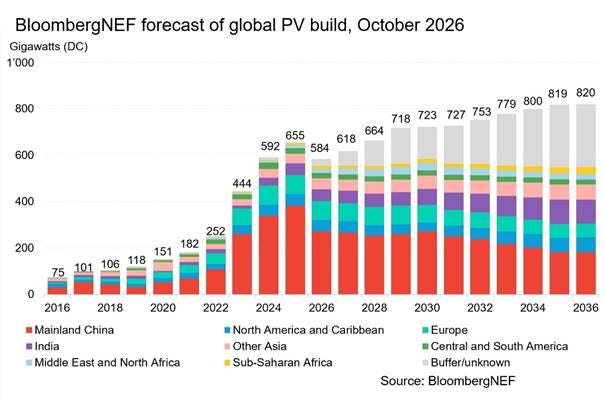
• BNEF expects the U.S. to add a record 89 GW of clean capacity in 2026 and set another high in 2027, driven by data center demand and expiring tax credits (and despite persistent and staunch opposition and blockages from the Trump administration). Link.
• Generation from U.S. solar projects under 1 MW specifically also grew from 18,812 GWh in 2016 to 92,979 GWh by the end of 2025. Link.
• China’s top five solar makers (Longi, Trina, Jinko, JA Solar and Tongwei) shed 40,589 jobs last year, a 21% drop following a 31% cut the year before, as Beijing cracks down on overcapacity. Link.
• The DOE granted $581 million toward 84 grid projects spanning eight states in TVA territory, adding ~2.5 GW of capacity ($331 million in cost-share, $250 million direct), then followed a week later with $967 million for grid resilience programs run by states and tribes. Link.
• Google will pay Entergy Arkansas $600 million to cover grid upgrades and a solar PPA tied to its data center expansion, but the utility restructured the payment as a prepayment that enters its rate base, adding ~$5.77/month to every customer’s bill via a rider that funds $3.9 billion in projects. Link.
• Base Power hired former Maine PUC chief Phil Bartlett as senior director of regulatory policy and retained Cassidy & Associates to lobby on permitting reform as the home battery company expands beyond Texas. Link.
• Australia’s Snowy 2.0 pumped hydro project will now cost A$22.2 billion (~$16 billion), more than 11x its original estimate, reminiscent of other recent cost overruns for energy megaprojects in the U.S. and other countries (proving we’re not the only ones who have a hard time building infrastructure on time and within budget. It could reach up to A$25 billion by some estimates and won’t be fully commissioned until late 2029. Link.
• Virtus Solis, a Troy, Michigan startup developing space-based solar, signed the sector’s first PPA: 20 years of power from its debut 100 MW solar satellite to Chicago data center developer Brae Systems, beamed to a dedicated receiving station in Illinois, with an option to expand to 250 MW. Link.
Fossil fuels
• A Bloomberg/The Examination investigation found the World Bank’s voluntary Zero Routine Flaring pledge, signed by 60 companies, is riddled with loopholes. ~2,000 flares were lit in over half of clear satellite observations in 2024, hundreds of which were run by signatories like Exxon, Occidental, and TotalEnergies. Total flared gas worldwide has also still risen 9% since the initiative launched, which also flies in the face of other voluntary pledges, such as the Global Methane Pledge (which signatory countries signed to commit to cut global human-made methane emissions by at least 30% below 2020 levels by 2030 [0% chance that happens at this point]). Link.
• The EU confirmed a one-year delay to methane reporting rules for imported oil and gas to avoid pushing fuel prices higher, though Energy Commissioner Dan Jørgensen says he doesn’t expect it to stretch beyond that. Link.
• Dated Brent crude oil prices hit $154/barrel earlier this month, its highest since 1991, as conflict in the Middle East drags on endlessly, constraining oil exports and driving inflation across basically all baskets of goods globally; gas pump prices in the U.S. rose 9.1% last month and fuel oil costs have soared 15.3% ahead of winter. the bright side, all that is boosting EV sales in many places (more on that below). Link. Link.
Nuclear fission and fusion
• The Nuclear Company unveiled “Prosperity One,” a plan for six Westinghouse AP1000s on a greenfield site in Lewis County, Kentucky. At 6.6 GW it would be the largest nuclear plant in the U.S. and the country’s second-biggest power plant after Grand Coulee Dam; construction is targeted for 2028, but cost, financing, offtakers and an online date are all undisclosed as-of-yet. Link.
• The nuclear IPO window meanwhile, which was running hot, has shifted to a colder temp as we transition into the middle of autumn. The Nuclear Company shelved its 2026 IPO (it had not filed a confidential S-1) after Holtec canceled its own offering last month. Recently listed nuclear companies have also seen share prices fall considerably. Form Energy also pushed its IPO to next year, signaling that the IPO window for energy startups more generally may have run out of steam a bit, after months of frenzied enthusiasm given demand for data centers and computational power generally. Link. Link.
• Still, major tech companies continue to bet on reactors, especially existing reactor designs. Google signed a deal with Constellation to finance 890 MW of uprates across 11 reactors in Illinois, Pennsylvania and New Jersey within PJM, and Amazon signed a 20-year Constellation deal committing more than $3 billion to upgrade Calvert Cliffs in Maryland. Oracle also inked a $300 million nuclear power purchase from a NextEra plant in Wisconsin. Link. Link. Link.
• The NRC is issuing TVA a construction permit for a 300 MW GE Vernova Hitachi BWRX-300 at Clinch River. That’s only the second permit for a novel reactor type granted in decades, and it could become the first U.S. commercial SMR to formally come online. This news comes six months after TerraPower got the green light to build its sodium-cooled reactor in Kemmerer, Wyoming. TVA aims to have its reactor running no later than the end of 2033 (a more realistic timeline than most will admit to), but it hasn’t set a construction start date. Ontario Power Generation’s Darlington unit may also beat it to the first operational North American BWRX-300 milestone. Link. Link.
• Blue Energy Global, which wants to build modular plants that convert from gas to nuclear, also applied to connect a BWRX-300 to the ERCOT grid. Link.
• JPMorgan made nuclear eligible for its $1 trillion green finance goal as part of a rethink of its $2.5 trillion sustainable development target, as it aims to dominate grid and electrification financing. Link.
• The DOE granted Vistra a ~$4.2 billion loan package to upgrade three of its nuclear plants and is backing research at Idaho National Laboratory to validate the science behind TerraPower and Southern Company’s molten chloride fast reactor, which would use liquid salt as both coolant and fuel. Link. Link.
• Poland’s state-owned nuclear developer officially committed to a second plant, with the U.S., France, and Canada all bidding on the contracts to build it. Link.
• The Commerce Department committed $175 million of leftover CHIPS Act money into Helion in exchange for a non-voting equity stake, its largest commitment to a single fusion company, and $85 million to Commonwealth Fusion Systems (also granting the government an equity stake). CFS will use the capital to develop and build semiconductors and power electronics for its future plants. Link.
Other clean energy developments
• Fervo Energy’s Cape Station in Utah began commercial operations a day ahead of its contract deadline and just 23 months after construction started, making it the world’s first utility-scale enhanced geothermal plant. The first 33 MW unit now sells power to Shell Energy; two more 33 MW blocks are due by January 1, 2027, and the remaining 400 MW, backed by Google, by 2028 for a $2 billion, 500 MW project. Link. Link.
• Seattle’s Endurance Energy generated power for nearly 30 seconds from an underwater volcano’s heat, running its Adélie test unit about a mile under the Pacific off Oregon. The company has raised $63 million and is planning a 2 MW project with Tonga. Link.
• Arbor Energy, founded by ex-SpaceX engineers and a Climate Capital portfolio company, ran its supercritical CO2 turbocompressor at high speed for more than two hours and says a 1 MW California demo is weeks away, with 25 MW by 2028. Its COO concedes no one will pay a green premium for captured gas power today, but says Arbor is near parity with combined-cycle plants once 45Q is included. Link.
• Terraform Industries, a company I’m quite excited about, claims it produced some of if not the cheapest solar power ever produced in North America, among many other technical updates from the founder that are worth delving intro in greater detail. Link.
Policy
• There’s a permitting deal winding its way through Congress that, to be honest, I haven’t been keeping that close an eye on. A lot about it sounds promising but it’s far from fully confirmed or across the finish line, and I’ll let other outlets keep you abreast of the day by day and hour by hour updates. How this bill will fare as the Midterm elections approach is also not something I’d claim to have much of any understanding of. Link.
• Amazonian deforestation in Brazil fell to ~3,300 km² for August 2025–July 2026, the smallest annual loss in a record dating to 1988. This welcome news lands as Brazilians voted in a tight runoff election between the incumbent, Lula, who has pledged to end deforestation by 2030, and Flávio Bolsonaro, the son of conservative former president Jair Bolsonaro. Lula won, which is good news for continued abatement of Amazonian deforestation and other climate change mitigation efforts. Link. Link.
• FEMA chief Cameron Hamilton told state officials they must build up reserves and capabilities to manage most disasters without federal help, as the administration plans a “national mutual aid” system among states and seeks waivers of environmental and historic preservation reviews for rebuilding. FEMA’s own report released Friday found state disaster agencies are typically understaffed, underfunded, and reliant on federal money. Link.
• South Korea set a goal of 100 GW of low-carbon additions by 2030, backed by ~$747 billion of government-led spending over the next ten years, aiming to become a top-three green manufacturing power in hydrogen steel, next-gen solar and solid-state batteries; new reactors are part of the plan. Link.
• New York, 21 other states, and four cities sued to block EPA’s repeal of all greenhouse gas limits on power plants. The EPA also argued that power plant emissions don’t endanger health or the environment, which, if courts agree, could stop future administrations from regulating them. Link. Link.
• The Trump administration finalized its fuel economy rules: It will lower requirements to 34.9 mpg average for model year 2031 cars and light trucks (vs. the Biden-era 50.4 mpg). Nearly two dozen states, led by California have sued. Link. Link.
• California Gov. Gavin Newsom signed bills letting homeowners and renters install plug-in balcony solar and requiring utilities to offer voluntary electrification incentives when a home’s gas service line is due for replacement. Link.
• The UK is cutting hundreds of millions from its £9,000 (~$12,000) boiler upgrade grant for heat pumps in England and Wales, part of Prime Minister Andy Burnham’s push to trim £2 billion for military spending. Link.
• Germany’s climate finance spending dropped from €6.1 billion to €4.75 billion ($5.31 billion) in 2025, a drop of more than 20% that leaves it short of its €6 billion annual pledge and makes it harder to fill the Global South financing gap left by the US withdrawal. Link.
• On the flip side and bright side, Canada is putting $2 billion into home efficiency retrofits to bring down heating bills and emissions. Link.
• Starbucks dropped or weakened its water, waste and carbon targets and cut its sustainability staff as part of $2 billion in cost cuts. Link.
Transportation
• The EU and China struck a deal that halves China’s projected hybrid and plug-in hybrid exports to the bloc over four years, capping them at 350,000 cars a year rising 6% annually, though actual volumes can still grow. This comes as European car manufacturers face immense pressure; many have conducted significant layoffs this year (e.g., VW laid of 100,000 people earlier this year). Link.
• Overseas sales of Chinese cars could still hit 12 million units in 2026, up 44% from 8.3 million last year, per the CPCA. Link.
• European battery EV sales jumped 70% year-on-year in September to nearly a third of sales across 17 key markets, and are up 38% year to date. Link.
• Hybrids, plug-ins and EVs also made up 23% of new U.S. light-duty sales in Q3; those hybrid numbers are higher while 100% plug-in car sales are still down a bit year-over-year after the federal tax credits expired. Link.
• Suzuki’s first electric kei car, the e-SKY, uses BYD batteries but undercuts BYD’s Racco to become Japan’s cheapest mini EV (~$13,500). Link.
• Tesla secured $30 billion in new credit lines for its Cybercab automonous ride hailing services and started mass-producing the long-delayed Tesla Semi in Nevada (7 years behind schedule but we’ll still take it). Link. Link.
• FedEx placed an order for 2,000 electric box trucks from Harbinger. Link.
• Volvo Autonomous Solutions and Waabi are hauling freight for Warp between Dallas and Houston (with a safety observer still aboard), joining Bot Auto, Aurora, Kodiak and Uber Freight on the corridor. Link.
Industry
• Antora announced a 5.8 GWh thermal battery at Pratt Energy’s biorefinery in Pratt, Kansas, which it says it will be one of the world’s largest battery systems in general. Link.
• Inlyte Energy landed its first commercial project, an 80 MWh iron-sodium battery powering snowmaking at Berkshire East Mountain Resort in Massachusetts, due online in 2028. Link.
• Rio Tinto and Rondo Energy began engineering work on a 360 MWh / 30 MW Rondo Heat Battery for the Yarwun alumina refinery in Queensland with ARENA support; if and when completed, it will likely be the alumina industry’s first and Australia’s largest thermal storage. Link.
• At least $260 billion in data center investment was scrapped this year in the face of sustained local opposition, with about $130 billion of that in Q3 alone, per Heatmap Pro. Roughly $1 trillion in projects now faces meaningful pushback, and about half of opposed projects end up canceled, even as Big Tech is expected to spend $800 billion+ on AI and data centers this year. Link.
• Finnish authorities temporarily halted Google’s two planned data centers in central Finland over unmet environmental standards, part of the company’s record €13 billion investment in the country. Link.
• Hertha Metals broke ground near Houston on a $100 million plant to make ~10,000 metric tons/year of high-purity iron, some pure enough for rare-earth magnets, which the U.S. otherwise imports almost entirely from China. Its single-furnace process takes low-grade ore straight to iron. It also expects to cut costs 25% versus blast furnaces, and says a planned 500,000-ton follow-on plant could emit up to 50% less even while using natural gas and 98% less if run on green hydrogen. Link. Link.
• Stegra says it needs more capital to finish its flagship Swedish project, with completion costs well above June estimates, and named former Saab executive Håkan Buskhe CEO, replacing Henrik Henriksson. Link.
• Bibby Marine launched the Staffordshire in Vigo, Spain, a first-of-its-kind battery-first electric commissioning service operation vessel for offshore wind that will carry a 22.4 MWh LFP system. Link.
Other noteable financing rounds and numbers
• Blackstone raised $8.7 billion for Blackstone Energy Transition Partners V, ~55% larger than its $5.6 billion predecessor, which closed in February 2025. A quarter of this fund is already deployed across six investments, including Flow Control Holdings and Dresser Utility Solutions, and nearly a third of commitments came from new investors. Link.
• Atlas Atomics, based out of Austin, raised a ~$400 million Series A at a $1.9 billion valuation led by General Catalyst to build heavy-water nuclear fission reactors that don’t require enriched uranium. Andreessen Horowitz participated. Link.
• Union Square Ventures, based out of New York, closed $900 million split between a $500 million early-stage fund and a $400 million opportunity fund, nearly doubling its core fund. While focused on AI deals, USV actively funds many climate tech companies. Link.
• Aligned Climate Capital, based out of New York, raised $387 million in financing (likely a mix of various capital stack components), led by Apollo’s Apterra Infrastructure Capital, to finance community solar projects. Link.
• Voltus, based out of San Francisco, which links flexible energy resources at homes and businesses to electricity markets, raised a $225 million Series D co-led by Generation Investment Management, Activate Capital and Vitol. Broadscale Group, Climate Investment, NGP, Ajax Strategies and All Aboard Fund also participated. Link.
• Type One Energy, based out of Knoxville, TN, raised a $200 million Series B co-led by Clutterbuck Capital and Breakthrough Energy Ventures to develop stellarator nuclear fusion plants. Lowercarbon Capital, Siemens Energy Ventures and SiteGround Capital also participated. The company is building its first plant at TVA’s Bull Run site. Link.
• Simple Energy, based out of Bengaluru, India, raised a $183 million Series C from the Arokiaswamy Velumani Family Office, Haran Family Office and angel investors for its electric two-wheelers. Link.
• Reverion, based out of Eresing, Germany, raised a €154.2 million (~$174.2 million) Series B led by Kembara to build reversible fuel cell plants that turn gas into power and surplus power into storable gas. Allianz, KfW Capital, Aurum Impact, Carbon Equity, Extantia, Energy Impact Partners, UVC Partners, the EIC Fund, alfa8 and Possible Ventures also invested. Link. Reverion has also previously been on our podcast—listen here (‘twas a live show we recorded in New York two Climate Week’s ago, in fact).
• Hertha Metals, based out of Conroe, TX, raised a $133.65 million Series A co-led by Khosla Ventures and Doerr Capital to make high-purity iron and steel in a single continuous furnace. The U.S. government (including $65 million from the Department of Defense), CEV, Pear Ventures, Gates Frontier, Niterra SUISO no MORI Fund, Toyota Ventures and Siemens Financial Services also participated. Link.
• Veir, based out of Woburn, MA, raised $110 million in a Series C co-led by Matter Venture Partners and Tyche Partners to build superconducting power delivery systems for data centers. LG Technology Ventures, Gates Frontier, Sabanci Climate Ventures, Hui Capital, Engine Ventures, Galvanize Climate Solutions, Piva Capital, Congruent Ventures and VXI Capital also invested. Link.
• Peak Energy, based out of Denver and San Francisco, raised $108 million in a Series B led by General Motors Ventures for its passively cooled sodium-ion energy storage systems. Maverick Silicon, Infinite Capital, Eclipse, Xora Innovation and LG Technology Ventures also invested. Link.
• Skeleton Technologies, based out of Tallinn, Estonia, raised $100 million+ led by Siemens to make supercapacitor systems that smooth power swings in data centers. It also raised a €5.7 million (~$6.4 million) partial secondary at a $1 billion+ post-money valuation, making it one of Europe’s latest unicorns. Link.
• Parallel, based out of Los Angeles, which is developing autonomous electric freight rail, raised $100 million in Series C funding led by Sequoia Capital. Link.
• Oro Mobility, the Hertz-owned robotaxi fleet management business being spun out as a standalone company, raised $80 million in “strategic equity” from a group including Steve Cohen’s family office, Cohen Private Ventures. It already has a deal to manage Uber’s planned Lucid/Nuro robotaxi fleet, starting in San Francisco, and rents about 45,000 vehicles to Uber and Lyft drivers. Link.
• Stand, based out of San Francisco, raised a $70 million Series C at a $1 billion valuation led by Saga Ventures to use wildfire, wind, and other hazard simulations to help homeowners physically harden propety resilience and make insurance cheaper / easier. Lowercarbon, Eclipse, Equal Ventures, Inspired Capital, Neotribe and Jackson Square Ventures also participated. Link.
• Rabot Energy, based out of Hamburg, Germany, raised $56.1 million in a Series B co-led by Endeit and DeepTech & Climate Fund to create virtual power plants with home energy devices also using dynamic power tariffs. vent.io, HV Capital, High-Tech Gründerfonds, Bosch Ventures, CNI and Acurio Ventures also invested. Link.
• Holyvolt, based out of Stockholm, raised $45 million from Zone II, Course Corrected VC and Fifth Wall to use AI with automated lab testing to explore and produce new battery materials. Link.
• Elax Energie, based out of Paris, raised €30 million (~$33.6 million) from Noria, Crédit Mutuel Impact and others to turn electric water heaters into energy storage sources. Link.
• Optivolt, based out of San Francisco, raised a $32 million Series A led by VXI Capital to embed electronics in solar panels to rebalance power between cells and add monitoring and safety. RA Capital, Valo Ventures and Atlas Innovate also invested. Link.
• Reactive Technologies, based out of London, raised €19 million (~$21.3 million) in debt funding from the European Investment Bank to build grid stability technologies to help better integrate and valorize renewables. Link.
• VoltR, based out of France, which gives used lithium cells a second life as new batteries, raised a €16 million (~$17.9 million) Series A from the SPI 2 Fund and Decathlon PULSE, plus €6 million (~$6.7 million) in grant funding from the Première Usine program. Link.
• Switched Source, based out of Chicago, raised $17 million+ led by Cubit Capital to make automated power-flow equipment that helps utilities add grid capacity without major upgrades. ABB, Emerald Technology Ventures, Red Cedar Ventures, Southern States and Southwire participated. Link.
• Novele, based out of Stamford, CT, raised a $17 million Series A led by Boisei Labs to pair energy storage hardware with AI software to manage commercial building energy use. Locke Health, Arup Ventures, Barton Malow and several major commercial real estate owners participated. Link.
• Epyr, based out of Paris, raised a €15 million (~$16.8 million) Series A led by SlateVC, to take cheap electricity and convert it into high-temperature industrial heat stored in firebrick. AENU, Daphni, WEPA Ventures, OVNI Capital and Aurum Impact invested. Link.
• ArkeaBio, based out of Boston, raised a $15 million Series A2 led by AgriZeroNZ for its livestock vaccines designed to reduce methane emissions. Breakthrough Energy also participated. Link.
• HyLight, based out of Brétigny-sur-Orge, France, raised $14.5 million for its hydrogen-powered autonomous airships it plans to use to inspect power lines, pipelines and railways. Rubio Impact Ventures, DRW, Teampact Ventures, Y Combinator and Ring Capital. Link.
• Reclinker, based out of Cardiff, raised a £10 million (~$13.2 million) Series A co-led by Clean Growth Fund and AP Ventures to turn demolition waste and into low-carbon cement in electric arc furnaces. Development Bank of Wales, Kibo Invest, Cambridge Enterprise and Zero Carbon Capital participating. Link.
• IMIO, based out of Chicago, raised a $12 million seed led by Sofinnova Partners to microbes digest leftover crop residue so its nutrients feed the following season’s harvest. Cultivate Next, Starshot Capital, Grow Together Salinas, Earth Foundry, and Serra Ventures participating. Link.
• Electric Plant, based out of San Francisco, raised $11.2 million in a seed round co-led by Onto Ventures and Climactic to read plants’ electrical signals with sensors and AI so growers can better manage water, nutrients and light. Ponderosa, Endeavor Catalyst, Ludlow, Michigan Rise, The Fund, Schox VC and Dug Song participating. Link.
• Veckta, based out of San Diego, raised an $11 million Series A led by Origin Ventures to run standardized bids from vetted suppliers to help businesses buy onsite solar and batteries. Tech Square Ventures, VoLo Earth Ventures, Cove Fund, Catalyst by Wellstar, Engage, Emerald Bay Ventures, She’s Independent Investments and Mobilize AI x Energy Ventures also participated. Link.
• Mana Battery, based out of Broomfield, CO, raised $10+ million in a seed round led by Voyager Ventures to build sodium-ion cells with no anode to reduce reliance on lithium and Chinese supply. Union Square Ventures and Buff Gold Ventures also invested. Link.
• Skyfly Technologies, based out of Banbury, U.K., which is developing electric vertical takeoff aircraft, raised an €8.9 million (~$10 million) seed led by HICO Investment Group. Archangel also invested. Link.
• Torch Systems, based out of San Francisco, raised $9.5 million from Khosla Ventures, Abstract, Construct Capital and Starship Ventures, plus $2 million in venture debt from First Citizens Innovation Banking. The company uses AI and sun-powered sensors to monitor remote infrastructure for fires, faults, and other problems. Link.
• UniSieve, based out of Zurich, whose gas-separation membranes serve plastics makers and point-source carbon capture, raised $9 million in a Series A led by Supernova Invest. Guenat Holding, Amadeus APEX Technology Fund, Founderful and Zürcher Kantonalbank also participated. Link.
• Linkener, based out of Valencia, Spain, which combines meters and software so companies can track usage, verify bills and scrutinize their power contracts, raised €7.5 million (~$8.4 million) led by Klima. GoHub Ventures also invested. Link.
• CarbonFarm, based out of Paris, raised $8.2 million in a Series A led by Colam Impact, to help rice growers build, finance and measure projects that cut methane and water use, Proparco, Suma Capital, Elea, Working Capital Fund, Albo, BPI France, Serena, Make Sense and Technmind invested. Link.
• HydRegen, based out of Oxford, U.K., raised $8 million in a Series A first close led by Genoa Ventures to make enzyme catalysts to replace precious metals in chemical manufacturing. Clean Growth Fund, First Imagine! Ventures, Oxford Technology Management, Headington Holdings, Oxonian, Foxglove Capital and Rapid Innovation Group also invested. Link.
• Outer Spaces, based out of El Segundo, CA, raised an $8 million pre-seed led by Upfront Ventures to build modular backyard pavilions with built-in solar and batteries for power and backup. Unlock Venture Partners, Mucker Capital and Genius Ventures invested. Link.
• Indurex, based out of Amsterdam, whose AI agents flag dangerous edits to industrial plants’ engineering setups and safety systems, raised €7 million (~$7.9 million) led by Contrarian Ventures, with Axeleo Capital and Curiosity also invested. Link.
• NEU Battery Materials, based out of Singapore, raised $7.6 million co-led by Shift4Good and SGInnovate to recover battery-grade lithium from spent LFP batteries and factory scrap. Lotus Singapore Group, M7 Holdings, and Paragon Ventures also invested. Link.
• Kodama Systems, based out of San Francisco, raised a $7 million seed co-led by Konvoy Ventures and Breakwater Ventures to builds remote-operated and autonomous systems for commercial logging equipment (also making logging operations more efficient and less emissions-intensive, as well as ideally also helping accelerate proactive forestry management to reduce wildfire intensity). Blue Forest Asset Management, NYA Ventures, Breakthrough Energy Ventures, Congruent Ventures, Dangerous Ventures and M1C participating. Total funding: $14 million. We’re also investors here at Climate Capital. Link.
• Laki Power, based out of Reykjavík, Iceland, raised $6.8 million in a Series A led by the NATO Innovation Fund, with ReykVC participating, to build monitoring tech for high-voltage power lines. Link.
• Blaze Energy, based out of Denver, raised a $6.5 million seed to make a compact bolt-on reformer that splits ammonia, methanol or LNG into hydrogen-rich gas so existing ship engines can burn alternative fuels without modification. Lomar Shipping plans an at-sea pilot next year, with commercial rollout targeted for 2028. Link.
• Giraffe Bio, based out of Buenos Aires, which designs compounds tailored to specific minerals so mines can pull more copper and other metals from ore, raised a $6.4 million seed led by Orion Industrial Ventures. BHP Ventures, Twynam, Air Capital and Baruch Future Ventures participated. Link.
• Cambridge Heavy Industries, based out of Cambridge, MA, raised a $6.2 million seed led by Azolla Ventures to make compact laser-driven fusion systems that make rare isotopes, which is one of many critical steps to make sustained fusion energy feasible. Overlay, the Mass Clean Energy Center, Neta Foundation, the Rothrock family and P3A also invested. Link.
• Pathways, based out of New York, raised a $6 million seed led by Sorenson Capital to convert manufacturers’ operational data into verified environmental product documentation. Zacua Ventures, Blue Lion, Positive Ventures, Great Wave, Titan Ventures, Heidelberg Materials and Pi Labs participated. Link.
• Ambio, based out of Helsinki, which applies AI and quality data to find and vet recycled plastics for manufacturers, raised a $5.7 million seed led by b2venture, with Montis and Lifeline Ventures participating. Link.
• Pythag Tech, based out of New York, which combines AI with lab experiments to optimize cultivated meat production, raised a $4.25 million seed led by Azolla Ventures, with Endurance28 participating. Link.
• Silvia Bio, based out of Sheffield, U.K., which profiles mammalian cells and develops media additives that raise biomanufacturing yields, raised a ~$4 million seed led by Northern Gritstone. Parkwalk Northern Universities Venture Fund, U.K. Innovation and Science Seed Fund and Wren Capital also participated. Link.
• Voltaback, based out of Levallois-Perret, France, whose software handles fleet management and pays back staff who charge company EVs at home, raised €2.8 million (~$3.2 million) from Serena, Aurélien de Meaux and Maxime Brousse. Link. Link.
• Cotierra, based out of Zurich, raised $3 million co-led by Carbon Removal Partners and PINC to build decentralized systems that turn farm waste into biochar and track the resulting carbon removal. Zürcher Kantonalbank, Carbon Drawdown Initiative, better ventures, GOTA Ventures, Hungry4Impact and Triple Impact Ventures also invested. Link.
More cool stuff
SOSV Deep Tech Summit
Looking for more events to join? The SOSV Deep Tech Summit—a free, virtual, three-day event that will bring together world-class founders, researchers, and investors to explore breakthroughs in climate tech, human health, and physical-world AI—is coming up soon. Check out the confirmed speaker lineup, which includes climate visionaries like Mike Schroepfer (Gigascale Capital), Milo Werner (DCVC), Laurie Menoud (At One Ventures), experts from Harvard and Princeton, a number of founders, and many others who will explore where funding is flowing and what the future holds for energy & climate.
→ Register here to save your spot.
Thanks for reading. For other good reads on similar beats, see here:


And one final reminder to check out the tipping pints event happening in NYC tomorrow!
— Nick
